I've kicked the whole ALA and Second Life business around long enough. It made me look back over my two years of posting about SL. I like what I've posted. I even fixed the link for the API story in my "I feel so much better!" article. [And then it broke again ... note to self, don't link to API stories.] While I will continue to keep in touch with my virtual librarian friends, I am making other acquaintances in SL in another area that is of great interest, although I hesitate quite strongly to say on a professional basis.
Spiritual direction is something I've been involved with for going on seven years. I am affiliated with Christos Center for Spiritual Formation and have been a facilitator in the Chicago area Tending the Holy program that trains people to be spiritual directors. I am on the Minnesota-based organization's board of directors. (Yes, I attend via Skype and have referenced this experience obliquely in a previous post.) SD is an avocation for me. When I write about it here in Die/|\Hard, I will be discussing the professional aspects rather than the spiritual aspects.
About six months ago, I was inworld, fidgeting in my Linden Home with some newly acquired furniture, when out of boredom I ran a search on spiritual direction and came up with a number of serious-looking hits. A lot of meditation is going on in SL! One of the groups caught my eye as I looked over the Viriditas Center for Contemplative Prayer Website. I visited their inworld site and was very pleasantly surprised when I attempted to meditate: it worked! I think because I am connected well with my avatar that I was able to relax and in a way be one with my avatar to achieve a stillness conducive to contemplative prayer.
After five years of exploring SL, it's still nice to be surprised.
Over the past few months, I've become acquainted with some of the regulars at the V Center and even attended one of the regular art gallery showings, listening to live musical performances. I even bought a painting! It took way too long for this foggy mind of mine to realize I had something to offer the center in its present winter mode: I could create a cross-country ski track. I've found X-C skiing to be meditative in first life and the only real drawback to doing it in SL is that the exercise is over in a minute or two, unless I created a very long looping trail.
"Automatic Cross Country System is a Scripted Automatic Poseball System that takes the avatars using it on a Programmed Cross Country Skiing path, which you create using an easy to use Waypoint Maker HUD." I'd done this for the snowy portion of ALA Island a couple of years ago. It's one of those very clever inventions that an SL resident developed that animates your avatar in the motions of swinging arms holding poles and legs wearing skis and guides them along a track via invisible waypoints. I can add code to speed up and slow down depending on whether the skier is going up or down a slope in the terrain. Putting it together required that I be given certain permissions to rez items on the sim and I honor the trust that went with that privilege.
Over the years, I have acquired a number of clever gadgets, some of which I never got to use at ALA Island. I have offered my copy of our labyrinth to V Center, although it may be too prim heavy for them to consider it. I also have a emPod, which may be an interesting meditation tool: a sphere in which the interior is paneled with video screens. We shall see. But it's good to be expanding my area of contacts beyond the library professionals.
BTW, the sim returned everything today in order to begin their Viriditas Spring. But the message I received was promising: "thank you so much for this idea. Next year we can start it right at the beginning of the season." Obviously, there is no issue that tier is too high to sway this nonprofit to leave SL.
Saturday, February 25, 2012

Sunday, January 15, 2012
Reflections on the Closing of ALA Island
Reposted | 01/15/2012
An acquaintance of mine told me about attending a presentation at Mayo Clinic's Second Life auditorium last Saturday (January 7) about a survey being conducted by a pair of Florida grad students. They are studying the relationship of first and second lives, looking for long-time residents of SL who are working professionally in virtual worlds. They have a list of kiosks facilitating the survey and I was pleasantly surprised to see one at the San Jose State University LIS sim. I was at that sim when it opened several years ago. Graduate students from their LIS program helped create ALA Island.

ALA Island in 2010 for "The Future Is Now" Conference.
When my friend asked the presenters if they had contacted any librarians in SL for help in their research, they were not aware of the prevalence of so many potential responders to their survey. This seems to be the lot of librarians, actual or virtual, that they are often an afterthought in research rather than a primary contact point. I shouldn't make too much of it, being an isolated incident. But in pondering the closing of ALA Island, I cannot help but wonder what really happened?
ALA Island Remembered
But first, let's remember some of the good times. I remember meeting with Galen Noltenius from the Washington Office on the roof of the first ALA building. Each office had a floor and egress by flight was over a tricksy balcony. The whole relationship thing struck home for me when I met Galen's operator at a DC Annual Conference. When he was struck and killed by a drunk driver several months later, it really impacted many of us in SL.
The theme for our first Banned Books Week had something to do with pirates and that was the first makeover for ALA's presence in a virtual world. I remember dancing and fireworks. Arrr! and a dandy pirate ship floating in the bay!
Then there was the design and building of ALA Island, with help from SJSU LIS students and Jeremy Kabumpo, a director at the grad school. I'd been to Epcot Center the previous winter and thought that it would be cool to use that as our blueprint, with a lake in the middle but over which we could have platforms for facilities. I didn't want to have buildings where doors were difficult maneuvering and why bother with ceilings when people could fly? The design team did a wonderful job. Librarians welcomed the presence of ALA to the InfoIsland Archipelago, which at the height of its development boasted 55 sims.

Loriene Roy, President of ALA, in her avatar form, presided over the National Library Week 2008 kickoff event. Pretty amazing.
We celebrated National Library Week in the spring and BBW in the fall, with attempts to provide support during Midwinter and Annual Conference for those who couldn't make it. We provided training for staff and had a lot of people sign up. One fellow who worked for ACRL, a division of ALA with many active members working in SL, took the whole thing as a joke. Training was during lunch hour, so it was voluntary, which set the tone for the way a lot of staff looked at SL.
And so it was always just a few of us who worked along with the dozens of librarians who are still working hard to show their institutions what kind of impact virtual librarianship can have. Take a look at the current calendar for the Community Virtual Library (CVL) and tell me this isn't amazing for a volunteer group. I saw last month that they even had an exhibit at the Science Fiction and Fantasy Faire, a terrific outreach to the larger SL community, which is a significant move toward integrating with residents. I am still humbled by these wonderful people long after I became no longer paid to care.

Young Adult author Cynthia Leitich Smith (aka Cynthia Zanzibar) gave a 2008 presentation about writing for the young adult market on the main stage. SL facilitates writers' workshops, connecting them in concrete ways across the continents.
In the fall of 2010, we reached out and had the avatars of well-known writers (Michael Stackpole, to name one) in the SL BBW Read-Off. A contest produced great videos that celebrated banned books. The following spring we facilitated "The Future Is Now" seminar that raised revenue and proved that SL activities could pay for themselves. (I felt that the registration fees were too low, which takes that ROI business even further.) But that was pretty much all she wrote. I think activity on the Island died down because the librarian members of ALA have their own places they need to support and since nobody on ALA staff besides Kay Tairov was working in SL, the Island went from being a symbol of ALA's presence to one illustrating the lack of ALA's staff's presence.
Last summer I went over the island and retrieved all of my gadgets that generated data on visits and teleported people from place to place. It was the beginning of the end, even though it was discussed as a remodeling effort. For more pictures and memories, I created a set of pages, A Pictorial History of ALA Island.
Oh, What a Shame!
If you read through the sampling of articles about the closing (see below), you can see admiration for the virtual librarian community but not enough outrage, IMHO. Many of these virtual librarians are not strongly supported by their own institutions, so it's all the more disheartening to see signs of ALA's diminished support. It's perhaps too early to know if the money that had been earmarked for paying tier is being used to help pay tier for the other virtual library sims or some other way of supporting work in SL. I am not privy to the decisions being made.
Metaverse Journal
Betterverse
I Live in Science Land (Be sure to read through on the comments since the post itself is divided into two topics.)
But here's what I wonder about most: for close to four years, the community of virtual librarians have been courted by ALA membership to organize and become an entity there. Becoming an entity would, among many benefits, have pressed someone on staff, besides Kay Tairov (who works in Membership), to work in SL. That could have made a difference. It still could but I am not hopeful.
I tried to talk to the ad hoc director of conference services at ALA, who is also a vice president of a company that handles exhibits for associations. The concept of virtual exhibitions may be on the bleeding edge but after an initial "your timing is right" reply from him in the fall of 2010, he soon was too busy to see me and then even too busy to reply to followup emails. ALA has a lot of members who just cannot afford to attend conferences but with a little training could attend them virtually via Second Life. The infrastructure is well-established. The cost would have been minimal and the CVL has proven over and over that they can justify ROI. This doesn't take away from the revenue generated by attendance of actual conferences but has the potential of building a desire to meet the virtual acquaintances met in SL at a future conference. Why is there such resistance to this?
There's an argument in the I live in Science Land blog about ownership of virtual properties and that using Opensim would be a better way for nonprofits to explore virtual worlds. I think they miss the point, that being the investment of money in SL isn't in the virtual objects or real estate but the relationships those objects facilitate. Please don't get me started on the economical aspects of paying tier or dedicating staff hours in SL when paper is still used to deliver information to members of ALA. The cost of producing one antiquated and useless newsletter would more than pay for a sim, and more to the point, be more efficient use of precious staff time.
ALA resisted the Web, too, so I guess I shouldn't be surprised. There's a much larger issue at stake here.
Virtual membership in associations is ephemeral and easy to ignore by overworked staff. What the CVL has accomplished is exactly what is needed to wake up not only ALA but many monetarily-strapped membership associations to the value of virtuals. As the premier representative body of information experts, ALA should be leading the way and not be dragged, kicking and screaming, on this cutting edge of the information highway.
But don't take my word for it, read this excellent analysis on the future of virtual worlds in Hypergridbusiness.
Tuesday, November 1, 2011
Archeology of HTML
Repost | 11/01/2011
I was helping Vanguard Technology (VT) migrate content from a small association's Website to a content-managed redesign. VT is using the Telerik Sitefinity CMS, which has really impressed me. I was given a step-by-step procedure and pretty much am following it in "robot mode." I have Sitefinity and the Website open in Chrome and the spreadsheet matrix of all the pages I'm working on open in Explorer via Google Docs, arranging the windows to click from one to the other. Underneath them all I'm running Spotify and listening to music as I have always done throughout my career. I think it's my ADD solution for concentration: overwhelm senses and focus ... something like that.
My big question: whatever happened to macros? Word allows you to create macros but it's so much smarter than me. I load an HTML file into it and without my consent it "value adds" more than two cents' worth of absolutely unnecessary code when my project calls for refining the code to bare essentials. Give me the pre-Windows WordPerfect, where back in the day, this ability to create macros meant in mere seconds you have a transformed file exactly the way you wanted it rather than Microsoft's idea of "what you really wanted." So it goes, and so I have a routine using Notepad deleting all the unwanted formatting codes.
I load the html content into Notepad and from the bottom use the up key to view the left-hand margin for the various abuses of p-breaks or no-breaking spaces between p-breaks (thank you Word Press for not letting me use codes here) to create line spacing. Need to find span for underlining and other abuses before I can whack the span breaks and so on.
As I go through year 2003 to the present, it's interesting to see the code getting less exasperating, for the most part, and I wonder if the early versions of these newsletters suffered from being done in Word with all the erratic coding that it often introduced. Example: the presence of extensive style codes and color designations tells me Word has been fussy about fonts. Just Saying. The association's Web editors seemed to tumble to the excesses of Word and in so doing, the files get cleaner as we near the present day. (One of the last ones I worked on took a half hour because almost every p-break was formatted, requiring a hunt of every instance of "span" and "style=" I could find.) Of course, we're migrating the content, the final shakedown in repurposing old text-based documents, kicking and screaming into the new age of electronic publications.
I'm not going to say it was fun, but it beat the hell out of filling my day scanning Indeed.com for work.
Note added 11-2-11: I decided to see if Codelobster had macro capabilities. It does not, but it saves all the items I've searched for so I can use a dropdown rather than type them in, and also serving as a reminder of what I need to hunt down. It highlights search items in yellow and gives me a count of replaced items, so I know that if I get rid of a specific span item (they used underline alot), and nuke the end-span codes, if the numbers don't match, I need to go after more spans. I also don't have to worry about word wrap issues that Notepad presents. Big thumbs up for Codelobster and a head scratch for why it took me so long to tumble to using it.
Monday, August 8, 2011
Counter-Intuitive Conferencing
Repost | 08/08/2011
During this prolonged period of unemployment, I began using Weight Watchers Online (WWO) and have dropped 20 pounds since April. It's really important to have positive things going on when you're in my spot career-wise.
One thing I've noticed about WWO is that McDonalds has a vast listing of their food on the WWO database. You type in McDonalds and you will find what the points are for almost everything on their menu. It's my understanding that they have to pay to have these entries listed. And you have to wonder why the red and yellow target of so many who descry fast foods as the enemy of good dietary practice would willingly submit their products to this kind of scrutiny and pay for it. A double cheeseburger alone is a third of my daily alloted points.
Why do they do this? Because if I so choose, I know what it's going to cost to indulge myself and on a rare occasion, stop at McDonalds. What this indicates to me is that the folks at Mickey D have done their homework. They understand the WW philosophy: you don't have to go cold turkey on fast food, only be aware of the cost when you indulge yourself. I have no idea of what the ROI is on that investment but I'm impressed.
I'm going to change gears now and try to apply this approach to nonprofits and conferences. A superficial analysis of the conference experience might lead one to think that the keys to raising conference attendance is to promote high-profile keynote speakers, provide engaging programming, entice popular exhibitors to attend, and find great cities and services to draw in attendees. All well and good. But the foundation of the conference experience is social and professional networking.
This conclusion is not drawn from polling attendees because I wonder if this foundation is even part of their consciousness. From my experience as a facilitator at many conferences and meetings, my observation is that the interaction of people at conferences is what brings them back even when the keynoter is not on one's personal A-list, the programming or the schedule sucks (sorry for the use of technical language there), and going to exhibits is an obligation one would rather avoid. I think the underlying driving force is people wanting to see the people on the other end of their emails or phone calls.
Let's go one step further, because right now most conferences and meetings are hurting big time. Is it because of keynotes, programs, exhibits, or location? Yes, it's due to the economy ... but again, the underlying factor is the absence of that core network of people who take the conference as an opportunity to reconnect. If colleagues A, C, F, and J aren't going, I'm not compelled to go unless one of those other "superficial" assets is an almost once-in-a-lifetime opportunity.
If you're with me on this, then it's entirely possible you'll jump ship when I return to my usual theme of how Second Life is the Next Big Thing for handling conferences and meetings. If face to face networking is so important, why would virtual conferences even be considered as some kind of alternative? As you read this (August, 2011), the Second Life Community Convention is going on and people from around the country are converging on San Francisco to attend both in actual and virtual forms. You will walk through the host hotel and see people online inworld. Two things are going on here: we are social creatures and the face-to-face experience is second to none in fulfilling that need. But when you've experienced colleagues in the virtual world, the face-to-face is compelling. It's the next best thing.
Oh yeah? What about Skype? you may ask. Well, I can see the actual person and hear him or her. Speaking from experience in talking to my son overseas and attending business meetings, the video portion of Skype grows old in minutes! I am observing the person (or people) on the other end. Even if the camera is wheeled through an exhibit hall or aimed at some kind of demonstration of a product, I am detached from the event, as an observer. This is true for just about any kind of virtual meeting format where video is thrown in. You know I'm right, there's a huge difference.
What happens in Second Life is immersive. You are not an observer, you are a participant. You may be chatting via text or speaking via voice, but more than that, you are doing something together with the other avatars.
When you understand how significantly different this experience is from observing something via Skype or other conferencing tools, then you can realize that virtual conferences via Second Life provide a compelling alternative to the face-to-face experience when someone cannot afford to attend the face-to-face version. An alternative, not a replacement.
I have heard this several times now that the hotels around O'Hare Airport do great business because of the central US location. People can fly in from around the country just to meet for a day and discuss business. The NFL Owners did it a month ago. And I suppose when you're talking about billions of dollars' worth of business, a round-trip flight in and out of Chicago is just a blip on the expense account. But it could have been done in Second Life for a lot less.
Second Life is not a huge investment. It does require investments of time for the participants to get oriented to the way it works. (Ask me how, I can help you.) But the cost of tickets for a dozen people to fly to Chicago pretty much covers the cost of a very simple parcel or sim in SL and my services to make it work. It's a hedge investment. Kinda like what McDonald's has done in spending money in a territory that on the surface seems quite hostile to McDonalds' business plan.
During this prolonged period of unemployment, I began using Weight Watchers Online (WWO) and have dropped 20 pounds since April. It's really important to have positive things going on when you're in my spot career-wise.
One thing I've noticed about WWO is that McDonalds has a vast listing of their food on the WWO database. You type in McDonalds and you will find what the points are for almost everything on their menu. It's my understanding that they have to pay to have these entries listed. And you have to wonder why the red and yellow target of so many who descry fast foods as the enemy of good dietary practice would willingly submit their products to this kind of scrutiny and pay for it. A double cheeseburger alone is a third of my daily alloted points.
Why do they do this? Because if I so choose, I know what it's going to cost to indulge myself and on a rare occasion, stop at McDonalds. What this indicates to me is that the folks at Mickey D have done their homework. They understand the WW philosophy: you don't have to go cold turkey on fast food, only be aware of the cost when you indulge yourself. I have no idea of what the ROI is on that investment but I'm impressed.
I'm going to change gears now and try to apply this approach to nonprofits and conferences. A superficial analysis of the conference experience might lead one to think that the keys to raising conference attendance is to promote high-profile keynote speakers, provide engaging programming, entice popular exhibitors to attend, and find great cities and services to draw in attendees. All well and good. But the foundation of the conference experience is social and professional networking.
This conclusion is not drawn from polling attendees because I wonder if this foundation is even part of their consciousness. From my experience as a facilitator at many conferences and meetings, my observation is that the interaction of people at conferences is what brings them back even when the keynoter is not on one's personal A-list, the programming or the schedule sucks (sorry for the use of technical language there), and going to exhibits is an obligation one would rather avoid. I think the underlying driving force is people wanting to see the people on the other end of their emails or phone calls.
Let's go one step further, because right now most conferences and meetings are hurting big time. Is it because of keynotes, programs, exhibits, or location? Yes, it's due to the economy ... but again, the underlying factor is the absence of that core network of people who take the conference as an opportunity to reconnect. If colleagues A, C, F, and J aren't going, I'm not compelled to go unless one of those other "superficial" assets is an almost once-in-a-lifetime opportunity.
If you're with me on this, then it's entirely possible you'll jump ship when I return to my usual theme of how Second Life is the Next Big Thing for handling conferences and meetings. If face to face networking is so important, why would virtual conferences even be considered as some kind of alternative? As you read this (August, 2011), the Second Life Community Convention is going on and people from around the country are converging on San Francisco to attend both in actual and virtual forms. You will walk through the host hotel and see people online inworld. Two things are going on here: we are social creatures and the face-to-face experience is second to none in fulfilling that need. But when you've experienced colleagues in the virtual world, the face-to-face is compelling. It's the next best thing.
Oh yeah? What about Skype? you may ask. Well, I can see the actual person and hear him or her. Speaking from experience in talking to my son overseas and attending business meetings, the video portion of Skype grows old in minutes! I am observing the person (or people) on the other end. Even if the camera is wheeled through an exhibit hall or aimed at some kind of demonstration of a product, I am detached from the event, as an observer. This is true for just about any kind of virtual meeting format where video is thrown in. You know I'm right, there's a huge difference.
What happens in Second Life is immersive. You are not an observer, you are a participant. You may be chatting via text or speaking via voice, but more than that, you are doing something together with the other avatars.
When you understand how significantly different this experience is from observing something via Skype or other conferencing tools, then you can realize that virtual conferences via Second Life provide a compelling alternative to the face-to-face experience when someone cannot afford to attend the face-to-face version. An alternative, not a replacement.
I have heard this several times now that the hotels around O'Hare Airport do great business because of the central US location. People can fly in from around the country just to meet for a day and discuss business. The NFL Owners did it a month ago. And I suppose when you're talking about billions of dollars' worth of business, a round-trip flight in and out of Chicago is just a blip on the expense account. But it could have been done in Second Life for a lot less.
Second Life is not a huge investment. It does require investments of time for the participants to get oriented to the way it works. (Ask me how, I can help you.) But the cost of tickets for a dozen people to fly to Chicago pretty much covers the cost of a very simple parcel or sim in SL and my services to make it work. It's a hedge investment. Kinda like what McDonald's has done in spending money in a territory that on the surface seems quite hostile to McDonalds' business plan.
Tuesday, April 5, 2011
I feel so much better! (Uncanny Valleys)
Repost | 04/05/2011 with updated links and revisions
I've never really been bothered that my avatar doesn't look like me and because of the present technology of Second Life, cannot look like my actual person. Nonetheless, I've read articles that bemoan the "retro" appearance of SL avatars and that people are looking for a better, more realistic platform. But it's now possible that when they find that realism, they may be ... um ... creeped out:
A theory called the "uncanny valley" says we tend to feel attracted to inanimate objects with human traits, the way a teddy bear or a rag doll seems cute. Our affection grows as an object looks more human. But if it looks too human, we suddenly become repulsed.
Instead of seeing what's similar, we notice the flaws — and the motionless eyes or awkward movements suddenly make us uncomfortable. (See AP article "Too real means too creepy in new Disney animation" and more recently, a review of the new Tin-Tin movie)What a relief! (Although, looking at some of the things that mesh technology is allowing creators to do, we may get some first-hand experience with the uncanny valley!)
I was in a conversation with a good friend the other night who felt that avatars cannot duplicate the authenticity of face-to-face discourse. For his side of the debate, he posited that eighty percent of communication comes from the unconscious, non-verbal gestures and facial "language" occurring in a face-to-face situation. My response, having experienced avatar-to-avatar discourse on a near-daily basis for the past four years, seems weak in comparison: I know authenticity when I experience it and it happens in SL.
I tried to counter his main point by stating that the avatar is an abstract expression of the actual person's unconscious as well as conscious attempt to create a virtual self. When you see my avatar, you won't see a middle-aged man with double chin, receding hair, buddha paunch and all the prejudgments that unconsciously creep into someone confronted by that appearance. My avatar is neutral in that regard. Perhaps that is an advantage rather than a disadvantage in communicating. It takes into account that "uncanny valley" by avoiding realism as well as unconscious prejudices.
Maybe, when all that unconscious verbiage of facial expression and body language is set aside, words become a more important part of the conversation. Even if a person is struggling to get his or her text to say what he or she wants, you, the listener/reader, aren't distracted by interpreting unconscious baggage but actually struggling to understand on the basis of creating a relationship free of the "thin slicing" of our own unconscious prejudices. In a situation where Voice is used, you have the vocal subtleties without the visual baggage.
On that basis, I say score another point for the power of presence in Second Life to create powerful relationships in a superb virtual social networking framework.
Tuesday, August 10, 2010
"Presence over Presentation"
Repost | 08/10/2010
Reading through the comments in reaction to Botgirl Questi's What Makes Second Life and Virtual Worlds so Stupid and Pointless (a title that is meant to be ironic) I note a comment about the librarians in SL and am glad to see someone getting what those wonderful professionals are doing. With very little support from their economically whacked institutions, these virtual world volunteers are putting together educational programs and events on their own time and dime. And the phrase that struck me in that comment was "presence over presentation."
My own initial experience of SL, which in November will be four years ago [and now working its way to eight years], was a feeling of being underwhelmed. I was invited to attend a discussion of education in SL at the Berkman Center, which is a simulation of the Harvard University institution bearing the same name. (I've told this story before, so if you've read it, go ahead and skip to the next paragraph.) Science fiction writer, David Brinn, in attendance as an avatar, commented that he couldn't believe SL was just a chatroom with bad 3D graphics. He was shouted down by a number of people in attendance. While he had expressed a sentiment that was floating in my mind, he was DAVID BRINN and he was being shouted down! It wasn't until a few months later, when a virtual colleague from the Washington Office of ALA met with me and showed me how to build things that I understood the vehemence that censured a world-renowned writer.
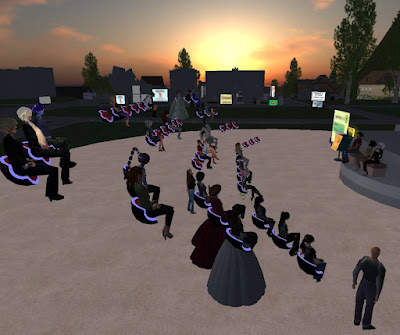
A group of librarians listen (at right) -- yes, Voice has been introduced -- to the announcement of the formation of the Virtual Community Library group, volunteers laying out their own money to pay tier for several islands to continue virtual librarianship in Second Life. In the photo below, a conference table can be clicked on to add chairs as people gather round for a discussion.
And that's the point of Botgirl's article. Until you've let yourself become immersed in a virtual world and explored the presence of people and their creations, you are still stuck in the shallows of presentation. How does one get out of the shallows? An approach that some librarians I know have taken is to create an alternate avatar and go native. Whether building, joining a role playing group, creating and selling clothing, or some other activity, we stepped outside the professional mask we wore when working in SL and dove deeper. The rewards were connections with real people and the reality of virtual goods, the actual value of what is created in virtual worlds and the tools that get the job done. Yes, some of those tools are not what Linden Lab provided, but what came out of work from residents.

The text floating in front of the ALA logo-emblazoned kiosk (at left) is generated via a script in the kiosk from data gathered from a Google Calendar dedicated to events for ALA Island.
For instance, several years ago, my "work" avatar, Oberon Octagon, met a wonderfully gifted scripter who is a project manager on business applications in first life in Juneau, Alaska. Among her many clever creations, she created gadgets in second life that connect with Google applications. (Her business has since merged with another talented scripter and is called MechanizedLIFE.) I set up Cog Kiosks throughout ALA Island that read information off Google Calendars to let visitors know about upcoming events. One only needs to update the Google Calendar to affect how the kiosks report, and that allows any number of people to post their events to a central calendar rather than go about editing each kiosk. More than one calendar can be merged together as well. Another terrific device she created is a Cog HUD that is worn by an avatar and accesses Google Calendars.
Personally, I find the graphics in Second Life to be beautiful. I don't want photo-realistic avatars or scenery. The beauty of the worlds within SL or any virtual worlds is in the eyes of the beholder. They are embued with the emotional presence of their creators. When you have walked the sims and talked to the creators who make it all possible, you see them in all their glorious patience and craftsmanship.
Reading through the comments in reaction to Botgirl Questi's What Makes Second Life and Virtual Worlds so Stupid and Pointless (a title that is meant to be ironic) I note a comment about the librarians in SL and am glad to see someone getting what those wonderful professionals are doing. With very little support from their economically whacked institutions, these virtual world volunteers are putting together educational programs and events on their own time and dime. And the phrase that struck me in that comment was "presence over presentation."
My own initial experience of SL, which in November will be four years ago [and now working its way to eight years], was a feeling of being underwhelmed. I was invited to attend a discussion of education in SL at the Berkman Center, which is a simulation of the Harvard University institution bearing the same name. (I've told this story before, so if you've read it, go ahead and skip to the next paragraph.) Science fiction writer, David Brinn, in attendance as an avatar, commented that he couldn't believe SL was just a chatroom with bad 3D graphics. He was shouted down by a number of people in attendance. While he had expressed a sentiment that was floating in my mind, he was DAVID BRINN and he was being shouted down! It wasn't until a few months later, when a virtual colleague from the Washington Office of ALA met with me and showed me how to build things that I understood the vehemence that censured a world-renowned writer.

A group of librarians listen (at right) -- yes, Voice has been introduced -- to the announcement of the formation of the Virtual Community Library group, volunteers laying out their own money to pay tier for several islands to continue virtual librarianship in Second Life. In the photo below, a conference table can be clicked on to add chairs as people gather round for a discussion.
And that's the point of Botgirl's article. Until you've let yourself become immersed in a virtual world and explored the presence of people and their creations, you are still stuck in the shallows of presentation. How does one get out of the shallows? An approach that some librarians I know have taken is to create an alternate avatar and go native. Whether building, joining a role playing group, creating and selling clothing, or some other activity, we stepped outside the professional mask we wore when working in SL and dove deeper. The rewards were connections with real people and the reality of virtual goods, the actual value of what is created in virtual worlds and the tools that get the job done. Yes, some of those tools are not what Linden Lab provided, but what came out of work from residents.

The text floating in front of the ALA logo-emblazoned kiosk (at left) is generated via a script in the kiosk from data gathered from a Google Calendar dedicated to events for ALA Island.
For instance, several years ago, my "work" avatar, Oberon Octagon, met a wonderfully gifted scripter who is a project manager on business applications in first life in Juneau, Alaska. Among her many clever creations, she created gadgets in second life that connect with Google applications. (Her business has since merged with another talented scripter and is called MechanizedLIFE.) I set up Cog Kiosks throughout ALA Island that read information off Google Calendars to let visitors know about upcoming events. One only needs to update the Google Calendar to affect how the kiosks report, and that allows any number of people to post their events to a central calendar rather than go about editing each kiosk. More than one calendar can be merged together as well. Another terrific device she created is a Cog HUD that is worn by an avatar and accesses Google Calendars.
Personally, I find the graphics in Second Life to be beautiful. I don't want photo-realistic avatars or scenery. The beauty of the worlds within SL or any virtual worlds is in the eyes of the beholder. They are embued with the emotional presence of their creators. When you have walked the sims and talked to the creators who make it all possible, you see them in all their glorious patience and craftsmanship.
Thursday, April 22, 2010
Second Life Is Past the Hype
A lot of people I talk to seem to think that Second Life was a fad that has peaked and faded. Not true. The following posts show it to be doing very well:
Here are three from one of my favorite SL bloggers, Dusan Writer:
Air Force Plans to Use Second Life Giving recruits avatars in SL is a fascinating plan ...
Eduction In Virtual Worlds A listing of his blogs over the years on education in virtual worlds.
Virtual Worlds and the Military Amputee The Amputee Virtual Environment Support System (AVESS) is discussed.
And other sources, which I admit is hardly exhaustive of what's out there:
Healthcare education in SL Dozens of hospitals, medical schools and health foundations have staked out space in the online community Second Life, where participants can build their own virtual clinics and stage just about any training drill they can imagine.
Medicine in the Virtual World More resources about what is going on in SL that is healthcare related.
Rutgers University About to open its Second Life simulation.
The one aspect of using virtual worlds for handling education and business continues to be the need for high-end computing power to make the most of it. That issue continues to be addressed with more powerful PCs and an economy that forces manufacturers to make them available more cheaply than ever.
Here are three from one of my favorite SL bloggers, Dusan Writer:
Air Force Plans to Use Second Life Giving recruits avatars in SL is a fascinating plan ...
Eduction In Virtual Worlds A listing of his blogs over the years on education in virtual worlds.
Virtual Worlds and the Military Amputee The Amputee Virtual Environment Support System (AVESS) is discussed.
And other sources, which I admit is hardly exhaustive of what's out there:
Healthcare education in SL Dozens of hospitals, medical schools and health foundations have staked out space in the online community Second Life, where participants can build their own virtual clinics and stage just about any training drill they can imagine.
Medicine in the Virtual World More resources about what is going on in SL that is healthcare related.
Rutgers University About to open its Second Life simulation.
The one aspect of using virtual worlds for handling education and business continues to be the need for high-end computing power to make the most of it. That issue continues to be addressed with more powerful PCs and an economy that forces manufacturers to make them available more cheaply than ever.
Subscribe to:
Posts (Atom)